
Dr. Todd Frisch - Face Reading, Restorative Medicine, Neurotoxins & Vibration - Episode #89
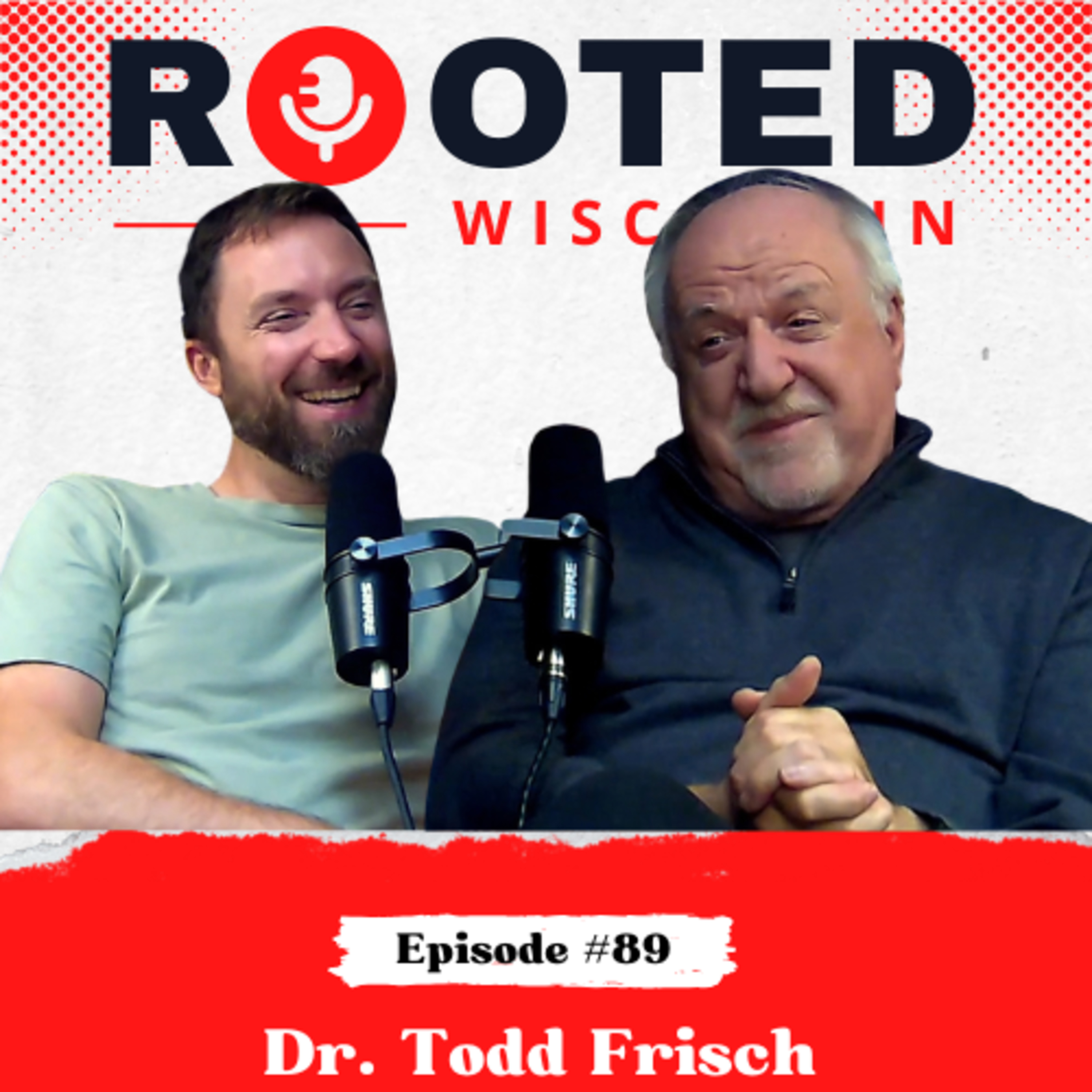


Dr. Todd Frisch is a doctor of chiropractic, functional medicine practitioner, author, and speaker with over four decades of experience in restorative health and holistic wellness, integrating functional medicine, traditional Chinese medicine, acupuncture, kinesiology, and facial diagnosis to help patients uncover the root causes of their health challenges.
He is the founder and technical advisor of SHAPE ReClaimed, an anti-inflammatory lifestyle and health transformation program designed to support systemic healing. Dr. Frisch is also the author of WTF? Why the Face: A Practical Guide to Understanding Health & Personality Through Facial Diagnosis, a comprehensive guide to reading physical facial signs to understand internal health and personality traits. A past president of the American Board of Chiropractic Acupuncture (ABCA), Dr. Frisch continues to educate and inspire audiences through his writing, speaking, and clinical consulting.
In this episode, we discuss his holistic approach to health, the art and science of facial diagnosis, the power of restorative medicine, the integration of AI into healthcare, the overlap of Eastern and Western medicine, and so much more!
https://drtoddfrisch.com/
Big shout out to our partners:Epic Mortgage – Your partner in homebuying, empowering communities, and supporting home ownership!
https://www.yourepiclender.com/rootedwisconsin
Nic Nac - CLEAN and TRANSPARENT, Nicotine PERFECTED. Use code "Wisconsin" for 20% off your order!
https://www.nicnac.com/
[0:00] Cold open
Dr. Todd Frisch: But it needs to come from your head and your heart. We spend too much time in our heads. I spent my career trying to convince people to get out of their heads and let their heart energy come in and play. Great story behind that, by the way.
Brad Zima: Lay it on me.
[0:25] From "quack" to restorative medicine
Todd: As a physician, I got into some different things — nutrition, and I got very fascinated by traditional Chinese medicine, anything that was kind of avant-garde. Understand, this was 1980, a long time ago. So I pretty much got the "quack" label. I didn't like being called a quack. But I was helping people, even though it was a different way, and I was developing a following. We relied on referrals; you don't just come out of the chute successful.
So medicine labeled me that, and then they said, "Well, there's some merit to what you're doing. We're going to call it alternative medicine." So all of us who thought outside the box practiced alternative medicine, which is equally disdainful as "quack," because it means you choose this or that. Actually, there was complementary medicine in between — complementary and alternative. Then it morphed into integrative medicine, and now it's called functional medicine.
I don't like any of those terms. What I like to call what I practiced is restorative medicine. We need to restore people to a place of health they should never have left in the first place. People have lost their way when it comes to health. There's so much information out there — some may be accurate, but most of it's pretty erroneous. It's a slippery slope, people are confused, and they need somebody who can help walk them through it.
[2:13] The paper mill and "you've got to know where to hit it"
Todd: I decided I needed to work in a factory because I kept dropping out of college. So I worked at the Brokaw paper mill, outside of Wausau, Wisconsin. They even changed the name of the town — it isn't even Brokaw anymore; it's called Maine, which I find odd.
In a paper mill, the machine area where they make the paper stinks, it's hot, and it's just an awful place. That's where I got stuck. They gave me the title "broke hustler," which I thought was kind of a cool title. What it means is that when the paper machine breaks and paper flies everywhere — this broken paper, the "broke" — my job was to hustle and put it back in a hopper to grind it back up. It sounded good, but it wasn't such a cool thing. There's a machine tender, a guy at the back end called the back tender, then a first hand, second hand, third hand, and the broke hustler somewhere in there.
I got stuck on the machine with a guy named Kowalski. He took a liking to me and would always ride my case. He'd say, "What's a smart kid like you doing working in a paper mill? Go get a college education and get a good job." I had dropped out of college — with straight A's. My kids bug me about this: "Dad, you're a college dropout." No, I stepped away from it. I didn't flunk out. I just couldn't find that piece of meat that was tasty for me.
Anyway, the point of this story: the machine quit working one day. This was union. I wasn't in the union at the time, but wherever you're assigned, you go and sit there all day. If the guy over on another machine is dying, it's not your job. So we just sat there and did nothing. In a paper company, if a machine doesn't make paper, you don't make money, so it's a serious thing. There were four machines, and they're huge — have you ever been to a paper mill?
Brad: Yeah.
Todd: So you know: they're two stories high and 30 feet wide, and big rolls come off them. The first day, the machine's not working, and the maintenance crew is there. The second day, they can't fix it. The third day, they call in an expert. He walks up, and I'm sitting on a picnic table with Kowalski, who's got his arm around me. The expert says, "Tell me what's going on." The maintenance guys tell him what's happening, and he says, "Got a 10-pound sledge?" One of the maintenance guys goes and gets a 10-pound sledgehammer.
Now he's walking up the stairs, and Kowalski pulls me in. He calls himself "the Polack": "I'm the Polack — you've got to listen to me." He says, "Son, that guy's making more money walking up those stairs than you're going to make in a month." That got my attention. I was 20 or 21. The expert walks to the top of the machine, goes toward the middle, takes his hammer and goes boom — hits it on top of the machine — and it starts to run. We're all sitting there with our mouths hanging open. He walks down, throws the hammer on the picnic table next to me, winks and says, "You've got to know where to hit it, son."
Here's the point. As a physician, I had two premises when working with patients. Because I did things differently, I tended to attract a different clientele — people who had tried everything else. I was kind of a last resort, at least early in my career. My first approach was to remove the obstacle to the cure: what's not allowing that patient to restore themselves to health? And the second was, "You've got to know where to hit it, son." Little did I know that statement would follow me through my career. It was a simple approach: remove the obstacle to the cure, then figure out where to hit it.
[6:06] Prayer, books and the head-heart connection
Todd: That was the start of my career, but here's another interesting story. I believe in prayer; I'm Christian. If you're not Christian, I'm OK with that. Whatever you are, be spiritual on some level and be good at what you are. I'm putting my stake in the ground, but if it's not for you, that's fine. Just be nice and be good at what you're doing.
If I had a tough patient, I'd get up early in the morning with my dog and my cup of tea and go to my antique rolltop desk — it's behind me in all the things I film. I'd pray. And I have a massive number of books. My wife says I have a book issue. I've never gone into a bookstore and come out without a book, and I don't think it'll ever happen. I'd pray about the individual, then walk to my books, sometimes even close my eyes, and let something message me. I'd grab a book, take it to my desk, flip the pages, stop and start reading. As cosmic and bizarre as that sounds, I can't tell you the number of times the exact information I needed came to me and helped the patient. Led by the spirit — I don't know, I don't care. Patients got better. It wasn't illegal, it wasn't immoral, but it was kind of odd.
This particular guy had a neurological disorder. And now for the rest of the story, as Paul Harvey would say: I never did help that guy. But the book I chose that day was called Medical Embryology. I turned to a section about a sperm and an egg, and I'm thinking, "God, this isn't it." It says the egg has a pulse of 72 beats a minute — boom, boom, boom. There are 300 million sperm flying around, and one finally figures out where to go. That sperm determines whether it'll be a girl or a boy: the egg carries an X chromosome, and the sperm donates an X or a Y. If it donates an X, it's a girl; if it donates a Y, it's a boy.
The sperm is beating an unbelievable number of times, and the egg at 72 beats. When they meet, both pulses stop for a moment, and then they beat together. Almost instantly, that one cell becomes two, two become four, four become eight, and the 16-cell embryo is called a morula. I'm a bucket face — we'll get to that when we get into face diagnosis — and we bucket faces remember useless stuff like that. It's still stuck in my head after all these years. Then there's this rapid cellular proliferation.
Then it switched to a new paragraph and said, "In this whirlwind of activity." I dare you: go to any medical library and find a medical book with the word "whirlwind" in it. You won't. This one does. It says that in this whirlwind of activity, a dark mass forms in the cellular proliferation. As the cells continue to grow, the mass separates, with tentacles connecting the top and the bottom. The top becomes your brain and the bottom becomes your heart.
There's a famous book by James Allen, As a Man Thinketh, taken from the Bible verse. I didn't help that guy, but what happened to me was that I realized your head and your heart are connected, embryologically. At that moment I realized I was all in my head and wasn't using my heart with patients. When I realized they're connected, I understood you have to treat people with both. It changed my career. It was a monumental moment.
I also realized that we men don't have the same ability to use our right and left brains together that women do. Women sense things. My wife would say, "I don't feel right about that," and I'd say, "I don't sense that. I'm never going to sense that." Here's the interesting thing: depending on the author, at about four to six weeks, the sex is determined. If the sperm donated an X, the baby is a girl. If it donated a Y, there's a 40% destruction of the connection between the right brain and the left brain. There's brain damage — and all the brain-damaged babies happen to be men.
Brad: Don't tell my wife that.
Todd: We'll have to do the 18-second gap that Nixon had and remove this from the tape. But you have to ask: why would the creative universe want our brains to be different? I teach a great class on the difference between men and women. It's absolutely hilarious, and I get requests for it all the time. The example I use: colonial times. You're on your porch with your two children and your spouse. The mother looks at the deer in the meadow and says, "Isn't that deer beautiful?" The kids say, "Oh Mom, it is so beautiful." And the guy looks at it and says, "It's beautiful, but I've got to kill it. Looks like meat." The male brain has to be different. The female brain is so connected; that's why women have this intuitive nature. I had to learn to become intuitive, and that moment in my career when I realized I had to think with my brain and my heart was when that connection occurred. I've become very sensitive and intuitive, but it's not natural for us men.
Brad: That's an amazing recognition, because I think that's where some of the misses on both sides happen. You need both.
Todd: You have to. The black and the white — it's the way it's supposed to be. We're driving society into a homogeneous nature that's not meant to be homogenized. We're supposed to be different. It's OK. It's not sexist. We are different, and it's rather fascinating.
[12:46] Truth is truth: asking "what's not right?"
Brad: So how does the leap happen from that recognition of the head and the heart to Eastern philosophical principles and Ayurvedic medicine?
Todd: Back to my Christian upbringing: I was raised Lutheran. My dad was Catholic, but my mom was Lutheran, and they separated. So I had that background. Then, as you learn, you take off in lots of directions. I spent a lot of time studying all kinds of philosophies, and I realized truth is truth. If Buddha says it or Christ says it, if it's the truth, it's true. No toupee necessary here. [verify against audio]
So much of our energy today is spent on affirmation. If you're conservative and Christian, you're not watching MSNBC, and if you're not, you're not watching Fox. I don't watch any of it. I think it all sucks; I bagged it. We need to seek information, but we're so into affirmation, and we've got a whole system — our iPhones and the algorithms — built around it. Charlie Kirk was killed one year ago yesterday. If you watch something about Charlie Kirk, all of a sudden your feed is flooded with that and things tied to the same kind of thinking. Whatever you watch, it gives you more of it.
As a physician, I was trying to be so specialized. We have our cardiologist, our heart doctor; our nephrologist, the kidney doctor; the orthopedist; all these specialties. And nobody's taking a step back and saying, "There's a human being in front of me, and maybe I need to look at them differently."
I believe that, philosophically, you've got to be two-thirds sick before medicine sees anything wrong. That's not a slam against my training. We're trained to ask what's wrong. It's beaten into our heads. Our decision tree starts there: this is wrong; if it goes this way, we make this decision; if it goes that way, we make that one. But if you're a physician watching this and you have any degree of intellectual honesty, you'll come to the realization I did. Patient after patient came in; I knew something was wrong, they knew something was wrong, but all the tests were textbook midline normal. So the answer, obviously, is 20 milligrams of Prozac — now you don't give a crap that you feel like crap. I didn't think that was a viable treatment option. It made no sense to me.
So I had a paradigm shift. I thought: what if I asked what's not right? It sounds like semantics, but it's huge. My entire career was based on knowing where to hit it, finding the obstacle to the cure, and looking at people by asking what's not right. It was a remarkable change in my career, and that's how I got into face reading. There's nothing out there to tell you what's not right — lots to tell you what's wrong.
Brad: That's amazing, and an excellent point of conversation. Western medicine seeing you once you're two-thirds of the way sick — I don't think that's necessarily a bad thing. It's just what it's built for.
Todd: Absolutely. It's how it was built, and again, it's not a slam against medicine. It's just inadequate when you're working with the real world. So many people get put on medications, and we kind of stop thinking as physicians. You can be at the bottom of your class, but your IQ is still pretty high to be a doctor — you don't get into medical school without it. And yet that doesn't necessarily equate to being smart.
Brad: For sure.
Todd: With the training I had, I really had to step back and ask, "If I bought into that, what would it do to my life and my career?" Take something as innocuous as hypertension — high blood pressure. You go to the doctor, and the doctor says, "You're hypertensive," and his first thought is, "Should I use a beta blocker or a diuretic? Maybe both." That's bad doctoring. Shouldn't the first question be, why is the blood pressure up? Is it a pump problem, where you need a beta blocker, or a kidney problem, where you need a diuretic? That's logic. You should have that discussion. It doesn't happen in medicine, because we're over-educated, and thinking outside the box kind of gets beaten out of us. We're all supposed to ask what's wrong and start a decision tree right there. When I made that shift, it was a wonderful day — scary, because it changed my world, and yet it was supposed to happen.
[18:57] Embracing change
Brad: Talk about how affirmation works. Even in that position, you're a cog in a big machine, and human nature won't let many people step into the discomfort, especially when it's their livelihood.
Todd: It is. Mel Robbins wrote a book called The Let Them Theory. It's fantastic. People think Mel is a he, but she's a she — a huge podcaster. There's a line in the book that says nobody wants to change, but one day you wake up and realize you have to. That's a scary moment for anybody. I was German Lutheran, so change is — "The light bulb's out? It'll come back on someday. Hang in there. Let's make some coffee and prepare refreshments, and it may come back." Change isn't comfortable.
I love quotes. In Downton Abbey, the butler, Carson, says, "What good would life be if it didn't change us?" That's in my quote box. We need to change, and we need to stop affirming. That's how we got specialization in medicine in the first place: people learned more and more about what they already knew a lot about, which is what I was doing. I realized I needed to look for information that would challenge my belief system.
I took some courses that were an absolute waste of time. My wife would say, "Why are you going to that?" I'd say, "I don't know." When I go to learn something new, I buy everything they're selling — all the books, everything. Then I step away and ask, "If I believe this, what would it do to my belief system? Would it change it? And if I changed, what would happen?" That's how I got into acupuncture, and homeopathy — talk about making your brain go tilt. It makes no sense at all, except it works. Now I'm an old guy, retired from active practice. My retirement didn't take, because I wrote this book, and then some guy from Green Bay called me. My dog's name is Lambeau, so I asked, "Can I bring my dog?"
Brad: He was out in the other room. He's here. I thank my lucky stars all the time that I'm in what seems to be the vast minority who embrace change and actually enjoy it.
Todd: Very few people are comfortable with that. It's an incredibly healthy statement to say you embrace change, because it's going to happen. There's nothing you can do about it.
Brad: At times I almost yearn for it.
Todd: You can be careful there. Not all change is for your benefit.
[21:51] Losing two children and never taking away hope
Todd: We've all got a story — life events that made us who we are. I've learned some incredible lessons in some incredibly sad ways. If I could have choreographed my life, I'd have learned them differently. My first two children died. That's probably why I have a first wife and a second wife. You can't think of anything more horrific than that. It's brutal.
The first was a beautiful little girl named Katie. She lived about 20 minutes, with thick black hair, which I can't understand given my lack thereof. The second was a boy named Brady, a redhead — who knows where that came from. Neither of them breathed when they were born. Katie died within 20 minutes, and Brady died in our arms at five months.
I was in school when Brady died. The last time he quit breathing, we ran to the ER. We had a husband-and-wife pediatric team. He was wonderful. She was an absolute witch. If you ever saw the movie Pulp Fiction — that hairdo was her hair. I still see that hairdo and feel some rage come into me.
We brought Brady into the emergency room, they took him, and I followed. They said, "You can't do that." I said, "Actually, I can. If he dies, he's dying in my arms. It's as simple as that." They said, "Calm down." I said, "I am calm." They're working on Brady, and the pediatrician — 5 feet tall, with that horrible hairdo — had her back to me. A nurse at the head of the table asked me a question, I answered, and the pediatrician turned around, looked up at me and said, "You realize there's no hope here."
I watched my right arm come off the side of my body, going for her neck. I literally had to grab my right arm. I'll never forget that moment, and it set the tone for who I am. I can't take away hope. I can't do it. If I know someone's got two weeks to live, I'm going to do everything I can to make a difference in their life. As awful as those events were, and as much as I'd like to have learned that lesson differently, it's a lesson I'll never forget.
Brad: Powerful. So powerful.
Todd: We've all got a story. You've got a story.
Brad: One hundred percent. One of the enraging parts of that is the sheer audacity to think, without a shadow of a doubt, that your perception of reality is everything that exists — that it's 100% confirmed.
Todd: Sadly, she was right. He did pass that day. The term "passing away" has a certain meaning for me, because he passed away. He ceased. He stopped. You know he's not coming back. It was remarkable — and life-altering.
[25:39] The sweet spot between ignorance and arrogance
Brad: In transitioning from youth to middle adulthood, I went through a period where now I hardly ever speak in absolutes, because —
Todd: Such a bad move. Do you always do that?
Brad: I don't always do that. When I think about 19-year-old me, I was such an arrogant asshole, talking in absolutes like I knew everything.
Todd: Let me hitchhike on the arrogance comment. This came to me in a dream. I had three dreams, and the voice in the last one was like James Earl Jones times 10 — the voice of God. An amazing voice, or an energy, I don't know. It said, "Son, you need to sit down for this. I'm going to teach you the sweet spot of life." And the voice went on: "The sweet spot of life is exactly halfway between ignorance and arrogance."
I don't mind being ignorant, because I love books. I'm a bucket face; I love to learn. Sadly, I've spent some time being arrogant. As a doctor, I think it's kind of in your DNA a little, sadly. But the sweet spot is halfway in between, and boy, I strive for that every day. Ignorance I can fix by reading a book. But arrogance? That's a bad thing. And that message came in a dream.
Brad: That's really reflective of a psychedelic experience and its takeaways.
Todd: I've had some remarkable dreams, and I don't know what that's about. I long to have them. The more I think about them, the less they occur, and when I don't think about them, they occur. It's a fascinating place.
[27:38] Archetypes, strawberry ice cream and the sage
Todd: Jungian psychology talks about four archetypes: the athlete, the warrior, the statesman and the sage — I think that's the last one. We start out looking in the mirror at our baseball stance, watching ourselves pitch, and it's all about us. Eventually you move from the athlete to the warrior. That's where you conquer: you get married, buy cars, buy homes. Then, with some intellectual honesty, you reach a point where you realize you need to give back. People join churches and civic organizations, start paying tithes, that kind of thing. And every once in a while, we touch that sage level. The moment you think you're there, you're no longer there. It's where you realize there's such power within you that if you can just shut up and tap into it, amazing things can happen.
I heard Wayne Dyer speak — one of the most amazing men I've ever met, an eloquent speaker and huge author who passed away about 10 years ago. He said, "I'm going to give you a test. There are four ways to get strawberry ice cream. Think about it, and we'll talk about it at the end." I thought of three; I didn't get the fourth. Most people didn't get three.
The first way is to get up and go get strawberry ice cream. The second is to tell your kid, "Go get me some strawberry ice cream," and they'll immediately do it. The third: you're sitting on a park bench thinking, "Jeez, I'd like some strawberry ice cream," and somebody says, "Would you like some strawberry ice cream?" You'd lose your mind. You'd call everybody: "You can't believe what just happened." The fourth way is simply to extend your hand, say "strawberry ice cream," and it appears. Now that's cosmic woo stuff — I almost said the S-word. Can I say that?
Brad: Oh yeah, for sure.
Todd: Cosmic shit. And yet, biblically speaking, Lazarus has been dead a number of days — rotting flesh in a hot place — and Jesus gets scolded for not getting there earlier to save him. Then he raises Lazarus from the dead. Whether you believe that or not, I don't care. I do. And then his disciples ask how he does it — do you put your right hand to the north and draw energy from the north? And he tells his disciples, essentially, "I just raised somebody clinically dead back to life, and greater things than this you can do also." Oh, I want a part of that. Whether you buy the story or not doesn't matter to me. I buy it, and I want to put my hand out and say "strawberry ice cream." I haven't done it yet. That's the sage area, and I'm working on it. But I've touched it a few times. I've seen things happen with patients in my clinic that were beyond my skill set, and yet I had success. That's a good day.
[30:44] Survival, success and significance
Todd: I had a mentor, my acupuncture mentor, Dr. Richard Yennie [verify spelling] — one of the most amazing men I've ever met. I wanted to be him. I was just a kid, 28 years old at the time, and I idolized him. He spoke seven languages. In World War II, at 19, he was an interpreter on the USS Missouri. He loved the Orient, Japanese and Chinese, and he was an interpreter on that ship during the signing of the surrender of Japan.
So I'm in this class. I'm young and brilliant — only one of those adjectives actually applied. We were a bunch of young doctors, and he was teaching acupuncture. He said, "You're going to go through three phases in your career. The first phase is survival." I was there at the time. I wasn't successful as a physician yet. I was honing my skills, trying to help people and get them to refer. He said, "The second phase is success." This was the Mercedes '80s, when success was defined by the car you drove, the house, the bank account, all the trimmings of life we strive for. I distinctly remember thinking, "What the hell is better than success?"
He let a pregnant pause sit there, and then he said, "You're all wondering what's better than success." I thought, "Yes, I am." And he said, "Significance." I've met many successful people who were pukes — awful.
Brad: Oh yeah, so many.
Todd: But have you ever met anybody you deemed significant who didn't have a peace about them, a correctness about them that's palpable? I've striven to be significant. I've been successful as a doctor. You get more stuff, but it's still stuff. I'd rather be significant than successful.
Brad: I'd argue there's an inverse correlation in a lot of cases. Don't get me wrong, there are anomalies. I've met plenty of outwardly "successful" people — for the listeners, I'm putting that in air quotes — who have a lot of material things and are also tremendous people. But that's the minority.
Todd: It is. But to make a difference in life — that's pretty special. As a physician, I had so many experiences that were beyond my capabilities. There's a spiritual nature to life — "greater things than this you can do also."
[33:46] Remote viewing and letting it happen
Brad: Along the lines of what you said about shutting up and tapping in, I've been diving a little down the quantum entanglement rabbit hole, and that led me to remote viewing. I don't know if that's anything you've gotten into.
Todd: I've studied it all. I love woo-woo. It's a nice place. It's like science fiction: anything's possible, and you can write anything because it's science fiction. But the world really is like that. Anything is possible.
Brad: And the key, from all the people who are trained in this or train others, is not to try to do it — not to put all your effort into it, but to just let it happen.
Todd: You have to let it happen. That's the sage part, the strawberry ice cream. Again, I've tasted it; I just haven't tasted it for a long period of time. But I've tasted it, and it's a sweet nectar.
Brad: It really is. I think most people can relate somehow. A lot of people call it divine intervention or something like that. Whatever it is, in those fleeting moments when it comes across you, there's so much comfort afterward for me.
Todd: It's amazing. It's way cool, as kids say to me.
[35:21] What face reading is and where it comes from
Brad: Let's jump into the X's and O's a little. The Packers are playing this weekend in Green Bay, so let's do it.
Todd: My dog is named Lambeau.
Brad: Who you got this weekend?
Todd: The Packers. I think they're going to win them all. They break my heart every year, but that's OK.
Brad: How do you describe the skill of face reading to someone?
Todd: It's woo-woo, and everybody thinks it's pretty weird until they have it done. Then it's, "How could you possibly know this?" You have to understand it's 5,000 years old. In China it's called mian xiang; in Japan it has its own name [verify against audio]. It's a technique and an art that has always been there. There were no X-rays, no blood tests, nothing. They had touch, hearing and smell, and they had to refine those senses to determine health. If you had a sweetness to your breath 3,000 years ago, you were probably diabetic, because ketones and ketosis have that smell. So it was built out of need, and then eliminated because we got so smart. We rely on tests to determine the health or sickness of an individual.
The problem I ran into, with any degree of intellectual honesty, was the patient where I knew something was wrong, they knew something was wrong, and all the tests were normal. Now what do you do? I couldn't give them Prozac. I just couldn't. So I looked for things that weren't findable. There's nothing to tell you what's not right, so I had to dig it out of the data. I studied Galen's four humors, the Jungian psychology we just talked about, and Ayurvedic medicine and the three doshas. I did a lot of study in traditional Chinese medicine, because there were a lot of books on it.
When I was studying Ayurvedic medicine, there was one book, by Vasant Lad, and I was fascinated by it. There was no internet in those days — this was 1982 — but there were a lot of books on traditional Chinese medicine. I found five-element theory fascinating, that way of looking at life, yin and yang, all of it. I've washed most of that terminology out of my writing. If I said you had dampness in your spleen or evil wind in your liver, you'd say, "What?" If I said you've got jock itch or migraine headaches, you'd say, "How'd you get that?" Because dampness in your spleen can end up as jock itch, and wind in your liver can end up as migraine headaches. So I removed those terms and westernized the data, because it didn't land the way I learned it. If I wanted to take this to the world in a way people would get, I had to change the language to give it a universality. If you stay in traditional Chinese medicine terms, you'll lose a lot of your audience.
[38:46] Reading politicians, and politics in families
Todd: It's like reading politicians: half the people are going to hate my guts. If I say something nice about Trump, all the Kamala people hate my guts, and if I say something nice about Kamala, the other side hates me. So I told my marketing team I'm not going to do politicians anymore.
Brad: You did a funny one on Trump, though. You did the whole face reading, and at the end I think you said something like, "You're going to give this guy the power."
Todd: Absolutely. There are nine face shapes, and Trump is an iron face. So is Hillary Clinton, so is Vladimir Putin, so is Winston Churchill. That square iron shape — they just look solid. They're strong, stable, stubborn. Everybody loses their crap over whether Trump is stable. Whatever — just let it go. I've seen families destroyed over politics lately.
Brad: Yeah, for sure.
Todd: It's crazy. My son is very angry at his father because he didn't like the way I thought. I told him, "You don't have a right to tell me how to think. I'm sorry, son." He wanted me to change my political thinking. Look, I'm Christian, I'm conservative, I'm traditional, but I respect a liberal, progressive approach.
If I'd been in northern Wisconsin when they were thinking about letting snowmobiles into the woods, I'd have been dead set against it. I hate that noise and that smell. But there was no business up there in the wintertime, and now it's almost as busy in winter as in summer because of snowmobiles. My traditional conservative approach would have been wrong. Compromise isn't a negative thing. People think compromise means you lose. No — both sides can win if you just think it through. And now we're losing our minds over political things.
I just had my 55th high school class reunion, which is weird, because I'm only 38 years old. I was never good at math. Some of my friends called and said, "We're going to a Brewers game. You want to come with?" And my son was giving me all kinds of crap. He didn't call me; he texted me these bile-filled things. So I went to the game and texted him back. His name's Toby. I said, "Toby, I had the most wonderful time with my classmates. Fifty-five years ago we were 18-year-olds. And the cool thing is, nobody talked about politics, because friendship is more valuable than politics — and even more so between a father and a son. You're letting politics divide us. It's absurd, and more importantly it's pathetic, because two years from now there will be a new president, and four years after that probably a new one too. Sometimes it'll be a Democrat, sometimes a Republican."
I like Robert Kennedy's thoughts on health. I'd love to make him president and let him run roughshod over the stupidity that exists in our health care system. I think he could fix it because he's got the right attitude about it.
Brad: I'm an RFK fan too. It was sad when he dropped out. It was a breath of fresh air that his campaign caught some momentum. But even with someone who aligns with a lot of what I believe, I'm consistently hesitant about politics these days. Aaron Rodgers just did a podcast with Cam Heyward —
Todd: I didn't see that. I saw him when he was on with Pat McAfee. He brought the house down.
Brad: In part two of this one, he shared thoughts on politics that pretty much capture how I think about it. Everybody gets so invested in being on these teams, and ultimately the coach doesn't really do anything for you. But we're willing to sacrifice a father-son relationship over somebody who is almost always yearning for power.
Todd: If you want the job, you shouldn't get it. Anybody who wants to be president shouldn't be given that job.
Brad: One hundred percent. I'm not naive enough to think I'll ever find somebody who checks all the boxes.
Todd: Never. My mom gave me the best advice. She had an eighth-grade education and was the youngest of 10 kids. We were raised incredibly poor, and the amazing thing is we didn't know we were poor. I love that about my mother. She said, "Look, vote for who you want to, but you support who wins. That's what makes this country what it is." That's good advice. I've had a hard time supporting any of them, to be honest, because I don't like what they do. I just pray they know more than I do when they make decisions.
Brad: They definitely don't. They might have more information available to them, but they don't know more than we do. And you captured it well: the person built to strive for that is not the person who will do the job well, in almost all cases. I do the same thing — I find a couple of things I hang my hat on. I'm very passionate about conserving public lands. I'm very passionate about public health — what we have access to eat, health care. I'm very passionate about public education. I try to pick whoever will move the needle a little in those ways. But I'm certainly not blinded into saying, "It's this person or nobody, or else we're not talking, Dad." That ain't happening.
Todd: How many Thanksgiving dinners went down the toilet over politics? Think about that. How about reading the room? Don't go there.
[45:28] Being called a quack and serving patients
Brad: Let's linger on something before we get into the tangible face reading. Early in your career, people called you a quack. Two-part question: how did you navigate that, and why did you keep swimming upstream? And how did you not let it affect what you were learning, seeing and doing in practice?
Todd: One, I was having success in unconventional ways, and success breeds passion. I wasn't going to change, because I was having success. I didn't like the moniker, but I liked what was happening.
I challenged my patients in several ways. The first thing I taught them was, "I'm your employee, and there's no union here. You can fire me. If you don't like something I do, fire me." You can do that with every doctor. Doctors don't want you to have that kind of power over them: "If you don't do what I tell you, I'll dismiss you as a patient." I'd think, "Good — go find somebody better." I didn't say that out loud, but it went through my head. I wanted my patients to understand that I had a servant's heart. I wanted to serve the public, and I did everything I could to make a difference in their lives in a way that was cost-effective, friendly and without a lot of side effects.
Second, I wanted them to think. That generation of "Oh, doctor, whatever you say" is gone. It's called the internet. People came in with a stack of printouts: "I read this on the internet. Would you look at these 88 pages and tell me what's going on?" People would bring in a bushel basket full of supplements and ask, "Which of these should I take?"
I'd ask my patients, "What do you think is the most important part of your car?" They'd say, "The engine." I'd say, "How about the steering wheel? A couple of wheels? The brakes? The accelerator?" "What's your point, doc?" "The point is, it's all important. Same with the body. You can't separate it out."
The one I liked most was when they'd bring in the bushel basket of supplements. I'd ask, "What do you think the most important supplement is?" They'd say, "I've been reading about vitamin D — it's kind of a prohormone, amazing for the body." Or, "I'm reading a lot about fish oil; it's cognitively and cardiovascularly enhancing." I'd say, "Do you want to know what the most important supplement is?" And the ladies would take out their purses, ready to write it down. I'd say, "You won't need that. The most important supplement is the one you're missing." And you could see their brains go, "Wow." The key is to find somebody who can figure that out — you've got to know where to hit it, son. Right back to that moment.
So I was motivated by my desire to serve the people who came to see me, in a way that was cost-effective and safe. And I was fully aware that I referred patients out for surgery and for medication every day. There's a time and place. So many people in my world of natural medicine — whatever you want to call it; I call it restorative — think that if it's medical, it's bad. No, I'm sorry. If you're going to blow your head off with a shotgun, or you can take 20 milligrams of Prozac and not do that, I'm two thumbs up for Prozac. It's a really good thing. Then let's get into what's going on and understand what's happening.
[49:23] Depression vs. despair and the "emotional concussion"
Todd: I had a patient I'd seen in previous years. She was Mormon, with six, seven, eight kids, and her husband was a bishop — kind of a head guy; they don't have paid clergy. I hadn't seen her for four or five years. When she came in, she looked like she'd aged 20 years. She looked frightful: a terrible rash, shaky, just awful. I asked what happened. She said, "My husband left me for his secretary." In the Mormon church, that's not a good thing.
Her cheeks were sunken in, with lots of zits on them. The cheeks represent the lungs. The emotion of lung deficiency — sunken-in deficiency — is despair. I said, "You've been diagnosed with depression, haven't you?" She said, "I have." I said, "I don't think you're depressed." She said, "Well, Dr. Todd, you're wrong there." I said, "I respect that, but I don't think you are. The D-word that describes you is despair. Depression is 'I'm depressed, and this is the reason why.' With despair, there's hopelessness."
I watched her brain change in front of me. It was remarkable. She closed her eyes and opened them. I said, "The meds didn't help you, did they?" She said, "No, they made me worse." I said, "Again, you're taking a drug for something you don't have. There's a hopelessness component." And her brain understood: "Oh, I'm hopeless, but I can work my way out of this." It was amazing. She asked, "What do you think happened to me?" I said, "You had an emotional concussion." She said, "That's really good — tell me about that." I said, "I don't know; it just came out of my mouth." One of those moments again. In my second book, I have a chapter on the emotional concussion.
[51:46] AI face reading and a military contract
Todd: Two gentlemen approached me — they'd seen me like you did — and said, "We love your book. We'd like to make an AI version of it." I said, "That's not going to happen. That's not doable." They said, "Actually, it is." One of them was an AI genius, and he said, "If you can teach me to read faces, I can teach a computer." I said, "I can teach you to read faces. We have a course for that." And off we went.
He said, "There's another guy I'd like to involve. His name is Doug. I'd like you to read his face." So I read Doug's face. Doug had had multiple traumatic brain injuries and suffered from PTSD, and I didn't know a thing about him. Doug was a 23-year veteran of special ops, and he's the CEO of the company now. I'm not the CEO. I'm a great businessman because I know I suck at business, so I steer clear of business stuff. Doug is doing a great job.
The point is, we were invited to a military base in Charleston, South Carolina. They wanted to talk about our ability to spot traumatic brain injury, PTSD, depression and despair. It turned out we were the belle of the ball. They were deciding whether to sign a contract with us, a five-year, multimillion-dollar contract. Doug talked a bit about the mechanics and said, "You've got to come up here, because I can't explain what you do." So I got up and said, "We would love to have this contract. But here's what we'd really love: we'd like to save one soldier from killing himself. And we can save many. That would be a 'well done, my good and faithful servant' kind of moment. We have the ability to detect traumatic brain injury, post-traumatic stress disorder, depression and despair early."
Some guy in the back raised his hand: "What's the difference?" I said, "Interesting question. The dictionary, and even the world of psychology, treat depression and despair as synonymous. They're not. There's hopelessness with despair, not with depression." At the break, this guy came at me like a heat-seeking missile. He said, "I know you're right. This is an absolute game changer. I'm in charge of the VA's suicide hotline program." And they signed the contract that afternoon.
To be labeled a quack and then have the government tell you they're going to give you millions of dollars — we haven't seen any money yet, by the way. But what they sign and what they do — we won't get into that. Even if that's the extent of it, I'm OK with it. I opened their eyes, and they were blown away. I diagnosed a lot of them right there. I'd say, "You get this, this and this," and they'd say, "How could you possibly know that?" Well, it's written on the face.
[54:59] Money, goals and the journey
Brad: Even if you don't get paid, you're fine with the outcome?
Todd: Money is a byproduct of services rendered. You want more money, render more service. It's as simple as that. Look, I've been poor. I guess I'd be considered doctor-wealthy — not making millions a day [unclear in audio], but it's a nice gig. Money was never my motivation.
I'm a bucket face, so we overthink, and we enjoy the process of thinking. In the '80s, there were Earl Nightingale and the Nightingale-Conant tapes you could buy — positive thinking and that kind of stuff — and goal setting was a big thing. In the mid-'80s, I had a goal of making a certain amount of money. One Friday night I realized my collections on Monday would put me over the top. I sat there and just cracked up: "Wow. So I'll be happy when I make twice that?" I realized goal setting wasn't important to me. It was the journey that excited me. I just love the process. Once I get there, I'm bored: what's next? I'm OK with that. Money motivates lots of people, and I understand that. But it's a boss that will make demands of you at some point, and it's going to be painful.
Brad: Absolutely. My line of thinking would be more, "You said you were going to pay me, and then you didn't." That would irk me a little.
Todd: That thought probably went through my mind at one point, but I really don't care, because somebody there heard something, and they're going to follow up on it down the road. It might be two years from now; I may be dead. But this company — it's called FDX Inc., Facial Diagnosis Inc. [verify name] — isn't going to go away. It'll be a multimillion-dollar company and get bought out, whatever. Great.
Brad: Maybe then you'll get the check.
Todd: But if I can make a difference in the lives of these soldiers, that's significance.
[57:37] Brad's face reading: astrology, bucket and tree faces
Brad: One hundred percent. Let's segue right into the face reading and do a little live here. I'll tee it up, because a couple of events happened right in a row. My wife is kind of an astrology believer. She knows all the signs.
Todd: I studied astrology. I couldn't get the physiological connection. It's very good psychologically, and I think it's accurate — get a good astrologer and they're freaking unreal. But astrology didn't tell me, "My pancreas isn't working right; I'm prediabetic." I bagged it because I couldn't apply it physiologically, not because it was hokum. I bagged it because it didn't give me what I wanted.
Brad: That's the perfect way to put what I was going to say. A week or two before you gave me the reading, my wife and I were talking about personality types, and we got on astrology. I don't know enough about it to have an opinion; my mind is relatively open to anything. She said, "Do you want me to read you what a Leo is?" It was a day where I was really being me. I said, "Sure, darling, if it'll make you feel good." She read these words, and I'm thinking, "Oh God, this is pretty spot-on. Dang it. Checkmate."
Then a week or two later, you called me with the results of my face reading. When you started rattling it off, there was some of the psychological piece — check, check, check. Then you went into these interesting physiological things as well. I'm excited to hear it again today. It was a similar feeling: there's so much I don't know, and somebody can tell me all of this because I sent three pictures of myself.
Todd: I did call your wife and get all the information.
Brad: Like the magician's trick — get everybody in on it. There are so many things in this that I don't know if we'll touch, and I'll let you go wherever you want. But some things in it discount that theory, because that's immediately where some people's brains will go: "Everything's online. He could have found it." There was about a week between when I sent you the pictures and when you gave me the results, and there are things in there that aren't available online that you called out immediately. When I hear that, it perks my ears up. How can I ignore it? So take me through it. I actually thought about shaving today to see if it changed anything, because I didn't know how much the beard affects it.
Todd: It's a factor. Some people grow very long beards and take on the energy of a tree face, even though technically they're not one. If you shaved it, they wouldn't be, but the energetic principle is still there — that length — and they want to spread their branches and protect.
In my world there are nine face shapes. I'll grab yours, if that's OK.
Brad: Do it up.
Todd: The important thing to understand is that your face shape is a gift from our creator — I mentioned that to you — and that puts a little more onus on the significance of it. That gift comes with some caveats: you must use it to honor that spiritual creator, and you must use it to help mankind. You have two gifts: you're a combination of a bucket face and a tree face.
A bucket is what I am. We're shaped like a bucket — bigger at the top. We like to put things in the bucket. We love to learn. We're thought leaders, we're intellectually persistent, and we're list makers. We never finish our lists, because God will take us home before we do.
Brad: There's always something to put on it.
Todd: Right. Then there's the tree, the more rectangular face, which the beard enhances. That's someone who likes to grow on their own and doesn't like to be trimmed back. As I said, the worst job for you would be indoors with no windows. If you were stuck in a room like this your entire life, you'd physically get sick. But your gift is your ability to spread your branches and protect. So your two gifts are your intellect and your desire to spread your branches and protect others. It's a nice combination. Everybody has gifts, and pointing them out can be life-changing for people. "Know thyself" — Plato said it, or maybe Socrates. I used to call him "So-crates." So that's our starting point: knowing who you are from your face shape.
[1:03:11] Sides of the face and the 21 features
Todd: I just love to think. I can sit in a chair all day and think. I don't need music or movies; I need a chair and my brain. My wife will ask, "What are you thinking about?" I say, "Nothing." "You can't think about nothing." "Well, actually I can, because I'm doing it right now." It drives her crazy. She's a king face, so she's a natural leader, but life is black and white: this is right, this is wrong. The only gray in that woman's life is in her closet. I could tell from emailing back and forth with your wife that she's very matter-of-fact, too.
So that's our starting point. Then we have the right and left sides of the face — really, the right eye and the left eye. The right eye is what we show the world. It's our public persona, what we want the world to see, and it's our mother's influence. The left is our private persona, and it's our father's influence. So if we see something predominantly or repeatedly on one side, there's a gender specificity. How I remember it: Mom's always right, because the right side is the female part.
Is it OK if I share this with the world? On your right side, what you show the world, you're very focused and very intentional. On the left side, there's a hint of sadness, and it's probably tied to a male. I don't remember if we talked about that. That's our opening salvo with everybody I work on, and it gets some thinking going.
Then there are 21 features on the face, and there's a duality to each feature. We start with the ears, then go to the top of the head and work our way down. The ears represent your kidneys, but they also represent your comfort with risk-taking and fear. The basic tenet of face reading is that more is more and less is less. You and I both have large noses. The nose is about power, drive, ego and leadership. So we both have lots of power, drive, ego and leadership ability. Can you abuse that? Absolutely. And with an even larger nose, there's more of it.
[1:05:14] Noses, plastic surgery and Michael Jackson
Todd: Everybody says, "That's a bunch of crap." I'll say a few words, and you tell me what comes to mind: Michael Jackson cut off his nose to spite his face. An unbelievably powerful man and a beautiful human being. I watched the movie, which was written by his family, and you could tell, because everything was about him being such a great guy. He had some issues. But I don't think he did any of the things he was accused of. I don't think he ever abused a child. He was a child himself. From a facial diagnostic standpoint, he was incapable of that. But at the end, he kept chopping off his nose because he didn't like it. At the end he had no nose — and no power, no drive, no ego, no leadership. So be careful what you do to your face, because it can bite you.
Now, should you never have any kind of plastic surgery? If you get up every day, look in the mirror and hate yourself because you hate your nose, get a nose job. But kind of stop there. I was lecturing in Santa Monica to a nice group of 40 or 45 people, so I could get to know everybody. I always like to pick people out of the audience for facial diagnosis. I'm respectful, but if you come up there, you're fair game. If you don't want me to bring something up, don't volunteer.
There were two women there, and I couldn't tell whether they were 30 or 60. Everything had been lifted and their faces were immovable. One raised her hand and said, "I'd like you to read my face." I said, "In no way do I want to hurt your feelings, but I can't, because you've had too much done." She and her friend said, "We didn't have anything done." The whole place cracked up, because everybody knew they'd had it all done. It took away the diagnostic value of the face.
Brad: So with the Michael Jackson thing, it's a nature-nurture thing? It's not given and then done — you can affect it by the changes you make?
Todd: Not only does a face change; it should change, because life happens.
[1:07:22] Fire faces and communicating with patients
Todd: My daughter is a fire face — very sensitive. She's an artist. Carrying on a conversation with her, as a bucket, I lose my crap, because I don't understand her. She's so sensitive, and she cares so little about the real world.
Brad: My wife might be a fire face. I'll show you a picture.
Todd: As a physician, knowing the face shape allowed me to communicate. You don't say to a fire face, "Look, you've got four things going on, you're in big trouble, and you've got to get on this right now." They'll turtle up, and they're not coming back. What you have to say is, "You've got four things going on, but we've got to respect your sensitivity. We're going to start working in one area. Normally I'd suggest supporting two or three things, but let's do one and start with a half dose and see how you do." A tear would come out of the corner of their eye, and they'd be all in. It was the words — the music playing in their head. If I want to swing dance and they're waltzing, we're not going to get along as doctor and patient. I've got to dance to the music in their head. It was such an amazing technique to help me communicate, and that's the key to this whole thing: our ability to communicate with one another.
[1:09:07] Customer service and COVID
Todd: There are so many more ways to communicate today, and there's such piss-poor communication. It takes over everything. Customer service — when you get a human being, you just want to send them money. Seven minutes into a conversation, you realize you're talking to a bot, and you completely lose it. I'm swearing at a computer, and it says, "Thank you, sir. How else can I help you?"
Brad: I always ask them if they're a real person.
Todd: That's probably wise. And we saw that great human experiment with COVID. My undergraduate degree was in microbiology, and a section of that is infectious disease. When this came out, I thought, "This is nothing." I'm not saying COVID didn't exist. It does. But how that card was played on us was absolutely sinful.
Brad: It was insane.
Todd: How about kids not seeing their teacher smile for a year? How did that go? Not being in school, not having that interaction. It was sinister. I don't think they can play that card again. I don't think we'll fall victim to that stupidity again.
Brad: Hopefully not too far the other way, though. If something comes up that's a worldwide thing and actually a big deal —
Todd: Let's go to the bubonic plague, which killed half the world's population. I remember with one of the SARS outbreaks, an English expert said millions of people were going to die, and when everything was said and done, 12 people died from it. Statistically that's insignificant — not for the people who died, of course. I struggle with those kinds of things. But I found facial diagnosis gave me those answers.
[1:10:47] What the ear can reveal
Todd: Again, there are 21 features of the face, and the ears alone have 21 different diagnostic indicators, so you can get into some pretty amazing stuff. A doctor friend was working with a patient who suddenly developed vicious diarrhea. They did all the GI studies and couldn't bring it under control. She called and asked if I'd talk to this woman. I'd met her once, kind of serendipitously. Her name was Sue.
I said, "Send me your picture. I'll do a face reading; it'll help me understand what to do." She had a notch in her ear that corresponded to age 11. She had been morbidly obese. As a physician, I hated weight loss programs. They're tacky and dishonest. But my wife gained some weight with menopause, and I put my thinking cap on. Now I have a company called Shape Reclaimed. My wife lost a bunch of weight, and we have hundreds of doctors across the nation using my system. Sue went on Shape Reclaimed and lost a tremendous amount of weight [verify amount]. I have a picture of her and my wife standing in one leg of her old pants.
But now she's got this diarrhea, and nothing's working. I see the notch on her ear at age 11, and I say, "Did anything happen around age 11?" The phone went dead. It was an abyss. I said, "Sue, are you there?" She said, "I am. I've never shared this with anyone." She had never married. She became a counselor at the high school, and they named a wing of the school after her. She was beloved in that community. She said, "I've never shared this with anyone, but I was sexually abused by my father at age 11."
It put a divot in her ear. It marked her. It was such a dramatic event that it put a mark on the body. I asked, "When did you start gaining weight?" She said, "Age 11." She gained weight so no man would ever look at her again. It was a coat of armor. Now she was losing the fat cells that formed that armor. In Chinese medicine, the large intestine — where the diarrhea comes from — pairs with the lung in what's called the metal element, and the emotion is despair. I said, "The reason you're having this diarrhea is despair. Your coat of armor isn't there anymore, and now you have to deal with it." And she dealt with it. She's fine. It still gives me chills, right now as I speak those words.
Brad: How did you know the notch was age 11?
Todd: It's in the book. It's under the ear, the first section.
Brad: Like a clock?
Todd: It is, and it's different for men and women. Ages 1 through 7 and 8 through 14 are on one ear and the other, and it switches between male and female. I could tell stories like that until the cows come home. Nothing short of remarkable. You just shake your head.
[1:14:50] Writing books with family
Brad: Talk about humbling. You realize what we don't know and what we don't access with our perception.
Todd: Until you learn what you can do. But look, we all read faces. You look at your wife and think, "OK, something's bothering her. What did I do?" You just read her face.
I wrote the first book with my daughter and the second with my wife, and we're still married, which is remarkable.
Brad: That's remarkable in itself.
Todd: Want to get divorced? Hang wallpaper with your wife.
Brad: For us, it's moving furniture. "Why are we moving furniture? It's good where it is." The process has nearly ended our marriage several times. "You've got to turn it this way." I don't understand which way to turn something to get it through a door. I just try to ram it through, and she gets so upset. Some of the biggest quarrels in our decade-plus together have been over picking stuff up and putting it down together.
Todd: It ain't good. I can't type. I'm not even a two-finger typist; I'm a one-finger typist. In school I always had girlfriends who would type my papers. When I'd date somebody, I'd ask, "Can you type?" "Yes, I can." "Great — I'll take you out for a nice dinner. Do you smoke?" "No." "OK, we're a match."
I wrote the entire second book in felt-tip pen. I went through 11 felt-tip pens and 400 sheets of tear-off 8½-by-11 paper. I'd give it to my wife, and she'd come in: "What the hell did you write here? I can't read your writing." "I'm a doctor, sorry." It ended up being a joy. She made me look good, because I kind of write like I talk, which isn't so good. She'd bring it back, and I'd say, "That's good, but it isn't exactly what I meant. I think it needs to be said this way." She'd say OK, and we'd go back and forth. We never had an argument the whole time.
Brad: That's the best. When you think about her personality type, that fits — you almost need that.
[1:17:35] ADD and the five elements
Todd: I married two king faces. My first wife was a king face — a beautiful, talented, incredibly intelligent woman — and it just didn't work. Probably the death of two kids had a lot to do with that.
Brad: Oh, yeah.
Todd: It's tough to take. But she was a bit of an anchor, and I badly need a tether. I need to be able to float, because I love the process of thinking, but I can't be locked down, especially underwater, which is kind of how I felt in my first marriage. That's not a slam against her; I was as guilty as she was in many areas. Linda lets me float. She won't let me float off, but I'll have all these great ideas — "Oh, there's another idea" — and off I go. I had ADD before they called it that, and I love my brain. I embrace my ADD. That's just a name we give it, and sometimes we end up becoming the name, which I think is unhealthy. I love how my brain thinks. I think everybody's fascinating.
Brad: I was going to ask about ADD and ADHD and the connection to this. One, can you see it in the face? And two, where does it live for you on the spectrum between fully Eastern philosophy and Western medicine?
Todd: First of all, there's not just one type of ADD. It's like saying "cancer" — there are lots of different kinds. I believe there are five different types of ADD that tie into the five elements of traditional Chinese medicine. I'm the water-element ADD, which is the philosopher: "But Mom, why? But why?" "Because I said so" was always the end result.
When I met Linda, my current wife, she brought her son in. He was 2 years old and had never slept through the night. She finally went to a doctor, who was going to put him on medication to get him to sleep, and Linda lost it: "No, I can't. It's got to be something else." He was a liver ADD. He woke up screaming between about 1 and 3 a.m. and was violent. You couldn't control him. But he's the pioneer, the wood element. He had a push; he had to run to the fences. He was running at nine months. He went through crawling very quickly and went right to running and scaling everything. He had to push the boundaries. That's who he was.
When I work with ADD, I work with the parents as much as the kids, because these kids aren't wrong; they're just different. ADD is a dopamine issue. That's what Strattera and Ritalin do — raise dopamine. Dopamine is the chemical of "more" in our brains. Men are governed by dopamine; women are governed by serotonin. Serotonin is the connector — "let's get along." Dopamine is "let's fix it, let's do something," and if some is good, more is better.
So David came in, and the fact that he was waking up between 1 and 3 told me it was the liver. He had a lot of food sensitivities, and I was able to remove those. I gave him a homeopathic formula, and the first night he slept through the whole night. Linda and her husband didn't sleep, because they thought I'd killed the kid — he had woken up screaming every night for two years. The formula calmed his brain down. It's called Kali phos, potassium phosphate, a tissue salt. We were able to lasso it in. But I told them, "Understand, he's always going to push the boundaries. That's who he is. He's the pioneer."
He's a Daniel Boone ADD. Daniel Boone had ADD. He couldn't sit still. He told his wife one day, "I heard about something called Yellowstone. I'm going to go check it out." Eight months later he shows back up at home.
Brad: That was a different kind of wife. A long tether.
Todd: A long tether, right. I'm sure Daniel Boone had ADD and was driven by the "more." So you have to look at everything and ask questions. Why is the blood pressure up? They have ADD — why do they have it?
[1:22:15] Big Pharma, GLP-1s and access to care
Todd: The world of medicine is fascinating, but we muck it up with too many words, too many possibilities and too many drugs. It's almost sinister. Big Pharma was built to help people get over a problem, and that was good: take this, get over the problem, move on. Then, in the late '50s and early '60s, the birth control pill came out, and medicine — Big Pharma — lit up: "People have to take this for their entire lives." It changed the whole process toward drugs you take forever. Has there been any reduction in hypertension or diabetes? Both are skyrocketing, and yet we have more drugs treating them than we've ever had. But we've never applied self-responsibility and lifestyle to it. Robert Kennedy is doing that. He's saying what you put in your engine determines how well it's going to run. Back to the most important part of the car: it's probably the gasoline.
So it's a process, a paradigm shift that has to happen. And it's wild to me that it's controversial.
Brad: It's easy to see how we got there. It's the bean counters. I have a marketing background and I've been in a lot of different businesses, and you see dollars and cents drive a lot of people's morals and motivations.
Todd: It's the sad truth.
Brad: The entire pharmaceutical industry has been captured by that. Sometimes it bugs me when the conversation goes down to the doctor or the scientist —
Todd: "Follow the science."
Brad: It's rarely that person. It's the machine that's working that person.
Todd: There's a real problem: the person who knows the most about medication has the least say, and that's the pharmacist. They spend four to six years studying pharmacology. The person who knows the next most is the doctor, and the person who knows the least is the drug salesman — and they're telling the doctor what to use. Then the doctor tells the pharmacist, "Give them this." Is there something wrong with that? It's pathetically wrong. And yet it's how the system is built, and it's now being milked to the point that it's an industry.
I follow investment companies like Goldman Sachs. What do they recommend investing in? Drug companies — especially the GLP-1s, Wegovy and Ozempic. Look, those things work. They're not going away. In my world, I'd teach patients that they had to eat better-quality food and change their relationship with food — do this, this and this. They got much healthier, but they had to put in a lot of work. Then you've got Ozempic saying, "Do whatever you want, just take this and you'll lose weight." However, in their ads, they'll say that if you stop it, all the weight will come back. Did that just increase sales a hundredfold, a thousandfold? "I don't have to do anything and I'll lose weight" versus "I've got to work hard to lose weight" — the drug is going to win every day with most people.
I had a very elitist practice. That sounds horrible, so let me qualify it: my patients were healthier, wealthier and more highly educated, and it was referral-only. I had an unbelievably wonderful tribe. I practiced in St. Louis. How do I help the Black woman in East St. Louis with six kids from four different fathers who has to choose between fuel and food? She doesn't know a carbohydrate from a protein. I would treat her for nothing; my heart said do it. But I wasn't capable of reaching her. She wouldn't come to me. She's on Medicaid, and they just say, "Take this and go away." It saddens me. It's a spiritual conundrum.
Brad: Does that have to do with the perception thing we were talking about earlier?
Todd: We've got a society that has been given things, and the more people are given, the more they expect to be given. That's why we're going to see a push toward a more socialistic approach. Those candidates are going to win elections, because you've got a population of people who have been given and given, and somebody will say, "We're going to give you more," and get the vote.
Brad: And think about how that works. That woman, whose life is probably chaotic, doesn't have the time —
Todd: — or even the inclination.
Brad: That's a perfect way to put it. She doesn't have the inclination to explore a solution beyond what she's told by the pharmaceutical commercial, whereas the healthy, wealthy patients you described are more inclined that direction.
Todd: When I started practicing, people just didn't want symptoms. Then people wanted to be healthier. Then it evolved to, "I want to be vibrant and healthy." By the time I left practice, people wanted to feel at 60 the way they felt at 30.
Brad: Anti-aging. That's a chic thing right now.
Todd: It is. I hate the "anti-aging" label. It says, "I'm afraid of dying." I never cared for it. But it was an evolution I like, and Kennedy is fostering that energy. It starts with self-responsibility. When you have generations with no self-responsibility, it's a bad system. How do you fix it? I don't know. That's what I'm probably thinking about when I'm "thinking about nothing."
[1:28:52] Barbara O'Neill, vaccines and COVID-era encounters
Todd: We're putting on a conference. Do you know who Barbara O'Neill is?
Brad: No.
Todd: She's Australian, and she got banished from practicing there because she didn't think too highly of the vaccine. I'm not against vaccinations. I'm against you telling me I've got to be vaccinated. That's where we run into a huge problem. Get vaxxed or don't get vaxxed — that's your call. It's a personal decision. "Follow the science"? You can't do that anymore, because Fauci pleaded the Fifth — whatever it was, 72 times. He's absolutely a narcissist. That was the most painful thing for him — worse than going to prison. He looked like an idiot to the world, and that destroys people like that. Time named him Man of the Year — not on my time. It was pathetic in hindsight.
Brad: That's such a crazy scenario. The entire thing was absolute bananas, and I think it changed the overall human receptiveness to that.
Todd: People said things that were unconscionable. I'm checking out at QuikTrip — as soon as I walked in, I thought, "I want to invest in this." It's the coolest store I've ever been in, and it's privately held. Bummer. Anyway, there's a little purple-haired lady checking out ahead of me, and a woman behind me. I said, "I've got to grab a newspaper," and the woman behind me said, "I'll save your place." I said, "Not necessary, I'm retired." So I get the newspaper.
This little old lady has a mask with two strings hanging and blowing in the wind, and it's filthy. She looks up at me with her purple hair and says, "You should be wearing an effing mask." She F-bombed me. I heard the voice of God, and he said, "Don't." It wasn't the arm again, but I'm thinking, "I have to," and he said, "Don't." What made it more interesting is that she bought two packs of Belair cigarettes, a quart of Tito's vodka and a package of powdered sugar doughnuts. And she's telling me to wear a mask. I finally said, "No, ma'am, I'm not wearing a mask, nor will I ever. Thank you. Have a good day." Where did that energy come from, that made that allowable?
Another time, I was at Hobby Lobby buying ornaments, which I've looked at every year since COVID. It was during social distancing, and my feet were two inches over the circle I was supposed to be standing in. My feet don't fit in a 6-inch circle — I've got 12-inch feet. The woman in front of me was on her spot, but she was large, and the kid at the register says, "Sir, get on your spot." I'm two inches over. I'm kind enough not to point out that she's three feet from my face. Then he yells at me again about something. I get up there, and — I ask forgiveness right now — I say, "Excuse me, are you of German descent?" He says, "Excuse me?" "I'm asking, are you of German descent?" "No, why would you ask?" "Because you're acting like a Nazi." I cringe every time I think about it. But he stepped on my last nerve, and I had to point out that it was ridiculous.
Brad: For some of the stuff that happened at that time, that's pretty tame. You can forgive yourself.
Todd: I still should have been nicer. I don't think the message landed, but it's OK.
[1:33:23] Being a light: "You can't measure what you prevent"
Brad: Not many lessons landed during that time.
Todd: But I think the thing here is that we need to be more of a light in this world. There's a book by Mark Batterson, a pastor in Washington, D.C., called All In. It tells the story of missionaries who called themselves one-way missionaries. They packed their belongings in a wooden coffin, knowing they'd die for their beliefs and be buried in it. One of them went to the New Hebrides in the 1800s, and he was in fact buried in his wooden coffin 35 years later. The locals carved on his tombstone: "When he came, there was no light. When he left, there was no darkness." That's significance. That's a legacy.
We need to be a light in this world. I feel bad that I went after that kid — I don't think he had the wherewithal to think it through. But we've got to be a light, and I use face reading to help me speak into people's lives and bring some light into them. It gives me the ability to communicate.
Back to Barbara O'Neill. We're doing a conference in St. Louis next March, and its title is "You Can't Measure What You Prevent." She's the keynote speaker, and I'll be speaking along with a couple of other doctors. From a health standpoint, you'll never know what you didn't get because you made a certain choice. There's such power to that title. I wish it were mine — I stole it from someone. There's a great quote attributed to Einstein: steal from one person, it's plagiarism; steal from many, it's research. So I research a lot.
Brad: It's like food. Every time I leave the grocery store with my $10 loaf of organic bread, I think there's no way to weigh the benefit. Most people are going to compare $10 to $3 and get the $3 one — OK, have your glyphosate. It's immeasurable, and a lot of people only have the capacity to see black and white. They don't have time to toil over these ideas: "I'm going to save $7, because my son needs to go to hockey."
Todd: I get that. I buy organic because I can afford it. Is it better to buy organic? Absolutely.
Brad: As soon as you do the thinking, it's pretty clear. But until you do, it's unknown. I think that's the light RFK is trying to shine.
Todd: It is. And again, it's a tough one. There's not an easy answer.
Brad: But that doesn't mean you shouldn't try. The best questions don't have easy answers.
[1:37:01] Traumatic brain injury and reading NFL draft picks
Brad: Let's shift gears. One part of the reading I found fascinating — something you couldn't have plucked from anywhere, because very few people know this about me, and even close friends wouldn't remember — is that you asked pretty strongly whether I'd had a traumatic brain injury. One, there's no way you'd know that other than from my face. And two, it was how you got there — something about eye level.
Kids get hurt in all kinds of ways, but I think this is pretty anomalous: when I was maybe 10 or 12, I fell twice, once on ice and once on concrete. Both times I was knocked out, or nearly, and I woke up on the same couch where my dad had carried me. As a parent now, I think about how terrified they must have been. I just woke up and said, "What happened?" Both times I had no memory after the moment. So how did you find that? And how prevalent is it in society?
Todd: So prevalent it's scary. In the simplest terms, when the pupil levels are uneven, there must be heaviness on one side of the brain. It's not because there's more brain. It has to do with inflammation. The body tries to put out the fire by putting water on it, which makes that side heavier. It's much more complex than that, but it's uneven pupil level, and it's 100% accurate.
A few years back, I was asked to read the faces of all 32 first-round draft picks and their coaches and see how they'd get along.
Brad: This is where I was going with this. That's fascinating.
Todd: Half those kids had had TBIs. It was pretty amazing. I remember reading Caleb Williams and Matt Eberflus, and I said, "In two years, one of these guys won't be here." Eberflus didn't make it through the season. He was very traditional; everything about him was by the rules. Caleb Williams doesn't play by the rules.
Brad: Not at all.
Todd: He's a bucket face, a deep thinker. I just hope he loses to the Packers every year.
Brad: He's going to be a problem for a while. He's very, very good.
Todd: We drafted Jordan Morgan that year, and he has acute perceptive abilities. He sees things, and he's very sensitive. Yelling at him will drive him in the wrong direction; you have to praise him differently. I would love to work for the Packers doing this. I can't judge their talent — that's outside my skill set — but I can tell you how a player will work with the team, what health problems he might have, those kinds of things. I think it would be of great value. They're putting millions of dollars into these people. They should be hiring me. That's not a direct pitch, but —
Brad: They should be. I've thought about that since you did my reading, through two lenses. One is player performance, even down to position — do you keep him at outside linebacker, or move him to end? The other is the NFL guarding itself against what's coming with traumatic brain injury and the research around it.
Todd: They're going to protect the shield. But ask yourself: before 1960, the incidence of dementia and Alzheimer's among NFL players was no different from the rest of the population. Today it's profoundly greater. The question is why. I think the answer is neurotoxins. When you consume aspartame for 10 or 20 years of your life — it's a known neurotoxin. You can look up the research. There's a book called The 100-Year Lie by Randall Fitzgerald that really addresses the history of aspartame. It's a known neurotoxin that causes brain cancer. Take a healthy brain and concuss it, and it's going to heal. Take a brain that's been exposed to neurotoxins and concuss it, and now we have a problem: CTE and everything we're seeing in the NFL. The brains aren't as healthy as they once were. You've got to ask the why questions.
Brad: It's fun to theorize about, and I could do it for hours, but I won't. When you called that out in my eyes, I thought, "Man, people would pay you millions, and you'd provide value in such a different way." I wondered if that had happened.
[1:42:38] Going viral, social media and AI
Brad: You did all the first-round draft picks — was that content you chose to do, or did someone contract you?
Todd: No, we put it online, on TikTok. My marketing team comes up with ideas; that's their job. You're in marketing, so you know — they're idea people. We never know what's going to work. That one didn't do well. We didn't get many views, and I thought it would be fantastic.
Then one Saturday, my wife shows me a picture of a guy and says, "The marketing team wants you to read his face. Do you know who he is?" I said, "No, but I'm not going to read his face." She said, "Well, you have to." I said, "No, I don't have to. I'm 72 years old. I don't have to do anything. I can do anything I want." She said, "You've got to read the face." So I read this guy's face. It was Andrew McGann, who is accused of killing a couple who were hiking in a park in Arkansas [verify charge status]; their two kids got away. Everything about him — no one would look at him and say, "He needs to marry my daughter." That's never going to happen. You don't have to be much of a face reader to know this guy has some serious issues. Twenty-four hours later we had 1.2 million views, and by the end of the week we had 2 million. It's nuts. If it bleeds, it leads, as they say. I don't enjoy reading criminals.
Brad: And there's no way to know with social media algorithms. I was texting with my last guest about this yesterday. I made two reels I thought would do fantastic, and they did about 10,000 views each. I put together a third one, kind of as an afterthought, and it hit 50,000 in a few hours. Nobody knows the special sauce; they keep it pretty tight.
Todd: I don't understand that world, and I'm concerned about it. I'm not fearful of AI. It's a tool; it's about who's using it. With a hammer, you can build a house or kill your neighbor. Same tool. How it's used — we have to be intelligent, thoughtful and respectful, and it can be a great tool. It's not going away. It's like GLP-1s; they're not going away.
[1:45:15] Curiosity and the future of education
Brad: It's fascinating. I haven't spent much time thinking about it, because I don't understand what's next. I like to think about what's next and see what's going to happen.
Todd: I'm concerned for my grandchildren. You and I are curious; it's just part of us. Creativity and curiosity — those are the two driving words. And what's happening because of AI and iPhones is that we're taking curiosity out of the equation for our kids. That's the end of mankind as far as I'm concerned. It's a dangerous thing. "How fast does a moth fly? Well, 33 miles an hour, because I asked Siri." But what Siri can't do is answer a question that's never been asked. It can't come up with a new idea. And we're taking that energy away from our children. That scares the crap out of me.
Brad: I've prognosticated on that a lot, because I work in higher education, and I'm thinking about what job security looks like in 10 years. We just rewrote our entire curriculum and redid our program through the lens of encouraging and enhancing curious problem solving.
Todd: Wow. That's brilliant.
Brad: Because that's what's going to be necessary. If you come to learn something, what's going to differentiate you in 10 years? If you're curious and can solve a problem that isn't typed into a computer, you'll be differentiated and provide value. You'll find something you're passionate about and throw all your eggs in that basket. I like to think we're pretty forward-thinking in that way.
Todd: This is the first I've heard of an educational institution thinking that way.
Brad: It's powerful, and it's necessary. I'm fortunate. I don't work in a university system where I'm beholden to grant money. I have an advisory committee that tells us what's happening in industry, and my two colleagues and I get to decide what we think is best for the students. It breeds this kind of thing. I think we're on the cutting edge, maybe the bleeding edge, but the curve is going to follow, because it has to.
Todd: It's not going away, so we have to embrace it. How you hug it is the operative question.
[1:47:59] Face reading for teachers and coaches; 528 Hz
Todd: As a physician, face reading was powerful. But how about for a teacher, to know that a kid is a fire face, so you can't come at them hard? Or that an iron face can take anything you throw at them and it'll bounce off? A king face is a natural leader, so put them in a leadership role.
Brad: One hundred percent.
Todd: Isn't that a good thing? I went to a high school in San Antonio through a real quirk. The athletic director was also the defensive coordinator, and he made $100,000 a year as defensive coordinator on top of his salary — at the high school level. Their stadiums hold 30,000. It's unreal. His father was a doctor friend of mine. I met him and read his face, and he called me and said, "What would you charge to come teach us this, so we know how to speak to our student athletes better?" He didn't call so he could be cool at a party. He wanted to make a difference in the lives of his kids. I said, "I'd be happy to do it, and I won't charge you at all. I'd love to."
I said, "Pick out somebody everybody knows." He chose the strength coach, an older gentleman who had worked at the Olympics at some point. I read the guy's mail. I had him down to the fact that he drank too much soda, and they were completely all in. They asked me to come back for an advanced talk. I want to do more of those. I want to help people understand people, because then it can be a more loving situation. Let's get rid of the judgment and talk about loving people.
Everything is about energy. Words have an energetic component — a hertz, a vibration rate. The word "love" has a vibration rate of 528 hertz. I did a lot of energy work: acupuncture, and a technique called BEST, which stands for Bio-Energetic Synchronization Technique. One patient, a Southern belle, said, "Dr. Todd, what are you doing?" I said, "I don't understand the question." "I come in here, you push on my arm, you put a needle here and there, and I feel better. What are you doing?" I got a check in my spirit — don't tell her. But I said, "It's my belief that I'm putting you into a vibrational rate of 528 hertz, which is the hertz of the word 'love.' What makes this even more important is that words like 'hate' and 'anger' have a vibration rate of about 100. And diseases have vibration rates. Cancer, for instance, has a vibration rate of 40 to 100, depending on the type. So if hate and anger are a big part of your life, you bring your energy down to a place where cancer can live."
There's nothing wrong with cancer itself; it just lives at a vibration rate that's very deleterious to us, who should be at 528. None of us stays there. Gandhi probably did; Christ did. It's not a normal place to be, but in my philosophy it's better to go there and leave than never go there. So I tried to put everybody who walked through my door into a state of 528 hertz.
And she burst into tears, and I thought, "Shoot, I shouldn't have said that." She said, "You never knew my husband, did you?" I said no. She said, "He was a horrible man. I stayed married because I felt it was proper. But he was hateful and mean. He was a multimillionaire, very successful, but despised by everyone in his life." Then she said he died of stage 4 pancreatic cancer, and she asked, "Had he not been that way, would he have died?" That's not a question you want as a doctor. I said, "Look, I don't know." But I think I do know. I think he brought that disease into his life because he lived at that vibrational rate. So be significant, strive for 528 hertz, and life is going to be better. It's that simple.
Brad: Drill that all the way down to just getting sick. If you have a couple of days where you're stressed, anxious and feeling low-vibration, more often than not you end up sick.
Todd: You do. It's pretty intuitive.
[1:52:51] Renard's cranberry jalapeño cheddar
Brad: What an amazing conversation. Let's have some cheese. What do you say?
Todd: It is Wisconsin, is it not?
Brad: It is. Super interesting cheese today. You can see I don't have it cut in slices, because it doesn't slice well. It's Renard's cranberry jalapeño.
Todd: Raynaud's is a disease where you have a lack of blood flow. So you get cows without good circulation, and they make their milk —
Brad: Doctor joke. Great joke. It's a cranberry jalapeño cheddar, but when I cut the package open, it crumbled like that, and when you bite it, it's like feta. Grab a hunk. Did you like it?
Todd: It's fantastic. To tell you the truth, it was better than I thought it would be. I'm not a big fruit-in-my-cheese person.
Brad: I know a lot of people are.
Todd: It's kind of a girly thing.
Brad: Not for the bucket face. But this one was very good. The jalapeños are what drew me in, and it's not really spicy at all.
[1:54:13] Lightning round: Wisconsin faces, supper clubs, antiques, Sherlock Holmes
Brad: These questions are a little lighter and a little more Wisconsin-related.
Todd: Because my dog is named Lambeau, we're now going to Wisconsin.
Brad: Exactly. Are there any regional commonalities you've seen in Wisconsin people when you've read their faces? Trend lines you see more here than elsewhere?
Todd: No. However, I can tell if somebody's from Wisconsin just by having them say "Wisconsin." If you're from Wisconsin, you divide it between the I and the S; if you're not, you say it differently [verify pronunciation against audio]. That's 100% dead on. But from a facial standpoint, no.
There certainly are regional aspects, though. If you go to Norway, people have very long noses with long, thin nostrils. Near the equator, noses are pug and the nostrils are huge. It's an evolutionary process. In northern climates, you want to warm the air coming into you, so the nose becomes longer to heat the air, and the nostrils are thinner so it comes in slower. At the equator it's hot, so you want to get the air in, get the oxygen out and let it out. So you'll see regional differences based on evolution, and they can have diagnostic value.
Brad: That's where my mind was with the question — whether lineage plays into it. Does that mean people from certain areas are predisposed to certain face shapes because they're more common there — more leaders from this country, more creatives from that one?
Todd: You would see it. Here in the States, we're a very homogenized group of people. We're very "liver" — we talk with our hands and talk loud. Go to Japan, and people are very quiet, but they can also tend to be very cruel. A lot of torture techniques developed by the Japanese were pretty creepy. We just kill someone instantly and get it over with; they kill you slowly. There's an interesting nature to what's in the world, and the key is to look at it, glean some diagnostic value and try to make a difference in people's lives.
Brad: Do you get many global requests?
Todd: I think I have books in over 50 countries, and I've read faces for people from probably 30 or 40 countries who sent in their pictures. It's an inexpensive thing to do, and you get a lot of value out of it. You can do it two ways. You can send in your pictures at wtfwhytheface.com [verify URL] —
Brad: I'll post all that in the show notes.
Todd: I can just read your face for $150, and you'll get a 68-page written report like the one you got. Or I can call you and spend 30 to 45 minutes on the phone; I charge $350 for that. So it's not expensive. If I wanted to make money, I'd charge a lot more. But I'd rather read a lot of faces. It's more fun.
Then there are the books. This was my wife's great idea, which I thought was fantastic. This is book one and this is book two. I wrote the first book with my daughter. She wrote every word in it other than "About the Author" — I wrote about her and she wrote about me. She did an absolutely phenomenal job. It covers the basics, the different face shapes. People would say — not a complaint, but a comment — "OK, now I know all this about me. What do I do?" The second book is the what-you're-going-to-do part. If you see a line across the forehead that dips in the middle, you have a prolapsed transverse colon: get some fiber, hang upside down, jump on a trampoline, walk. It's been very well received. Everybody's got a book in them, but very few of us ever write one. Both books were an absolute joy.
Brad: Fantastic. You're partial to northern Wisconsin. You lived up there for a long time. Whereabouts?
Todd: I lived in Florence, Crystal Falls and Iron River.
Brad: A good friend of mine is from Iron River.
Todd: Oh, really? I'm sure I know them. Her father was a longtime dentist up there.
Brad: Yeah. Lindsay. [verify family name]
Todd: She's as smart as she is beautiful. She's a great friend.
Brad: Isn't she working in the holistic medicine space up there now?
Todd: Yes, she's great. She was at my house three weeks ago. It was their anniversary, and they wanted to get away, so they spent three days at our house and brought their dog, Olive. Coolest dog ever.
Brad: Fantastic. Along those lines, when I think of northern Wisconsin, I think of supper clubs. What's your favorite northern Wisconsin supper club?
Todd: Smokey's [verify spelling]. It's owned by Liz Uihlein, and it's fantastic. It's so well done. Everything she touches, she does with excellence, and it shows. Interesting lady. Her guest houses are right across from my driveway. It's by far my favorite up there, with a great wine selection.
Brad: Nice. I have a great friend here in Green Bay named Chris who owns a private restaurant and does private events. He's a chef of that cloth — everything is excellent. You'd read my face and say, "I could never work for this guy," but man, I like the results.
Todd: Absolutely.
Brad: I leveraged AI a little to learn about you, so hopefully a couple of these aren't wrong. One thing I found was that you enjoy antiquing. Is that true?
Todd: I paid my way through school with an antique business. All my friends were flipping burgers and waiting tables, and I bought junk and sold antiques.
Brad: Hence your old rolltop desk. What's the best antique store in Wisconsin?
Todd: In Wisconsin, I'd say one in Princeton.
Brad: What makes it special?
Todd: Just quality stuff. I like oak. Now everything is mid-century modern, whatever the hell that is. They just have a lot of stuff I like. I can't remember the name of the store — Woolbridge or something like that [verify name]. It's my favorite antique haunt in the state. I'm sure there are others that are very good; I just like that one.
Brad: I always love going into an antique store and talking to the owner if they're there, because it's always an interesting person.
Todd: Absolutely. You never leave with a conversation you wish you hadn't had.
Brad: Another thing I found was that your childhood hero was Sherlock Holmes.
Todd: Yeah.
Brad: So what would be the biggest Wisconsin mystery for Sherlock Holmes to solve?
Todd: Wow, golly, what a great question.
Brad: I was excited about this one.
Todd: A Wisconsin mystery. I guess Ed Gein. I was alive when he did his things at the end of the '50s. I remember my mom saying, "We're going to go look at his house before the locals burn it down." So we drove south from Merrill, Wisconsin, where I grew up, to Plainfield. There was a line of cars that went on forever, all just staring at the house. I think the mystery there would be what was going on in his head. I don't even know if Holmes could crack this guy. I'm sure there are other mysteries; I'd have to ponder that a bit.
Brad: I've been thinking about that one since I wrote it, and I've flip-flopped a million times.
Todd: I'll go with that.
Brad: I love it. Well, it was an awesome conversation.
Todd: Geez, Brad, I live for these things. They're so much fun. I like the organic nature — nothing canned. This is joyful for me. Let's just talk, and good things come out when you just talk.
Brad: The pleasure was mine as well. I appreciate it.
Todd: Great. Thank you.